
The Economics of Decoupling: Why Revenue Per Employee Matters
In the pre-AI business landscape, growth was almost always a function of headcount. To service more clients, ship more code, or manage more accounts, you needed more bodies in chairs. Today, the defining metric of a company’s health is no longer total revenue or total headcount, but the ratio between them: Revenue Per Employee (RPE). This is the North Star metric for the AI era, serving as the ultimate litmus test for how effectively an organization is leveraging automation rather than manual labor.
The contrast between the traditional model and the AI-augmented model is stark. In a standard agency or service business, scaling is linear. If you want to double your revenue, you typically have to nearly double your payroll. This introduces a "complexity tax"—as teams swell, communication creates friction, and margins remain perpetually squeezed by overhead. You are essentially selling time, and time is a finite resource.
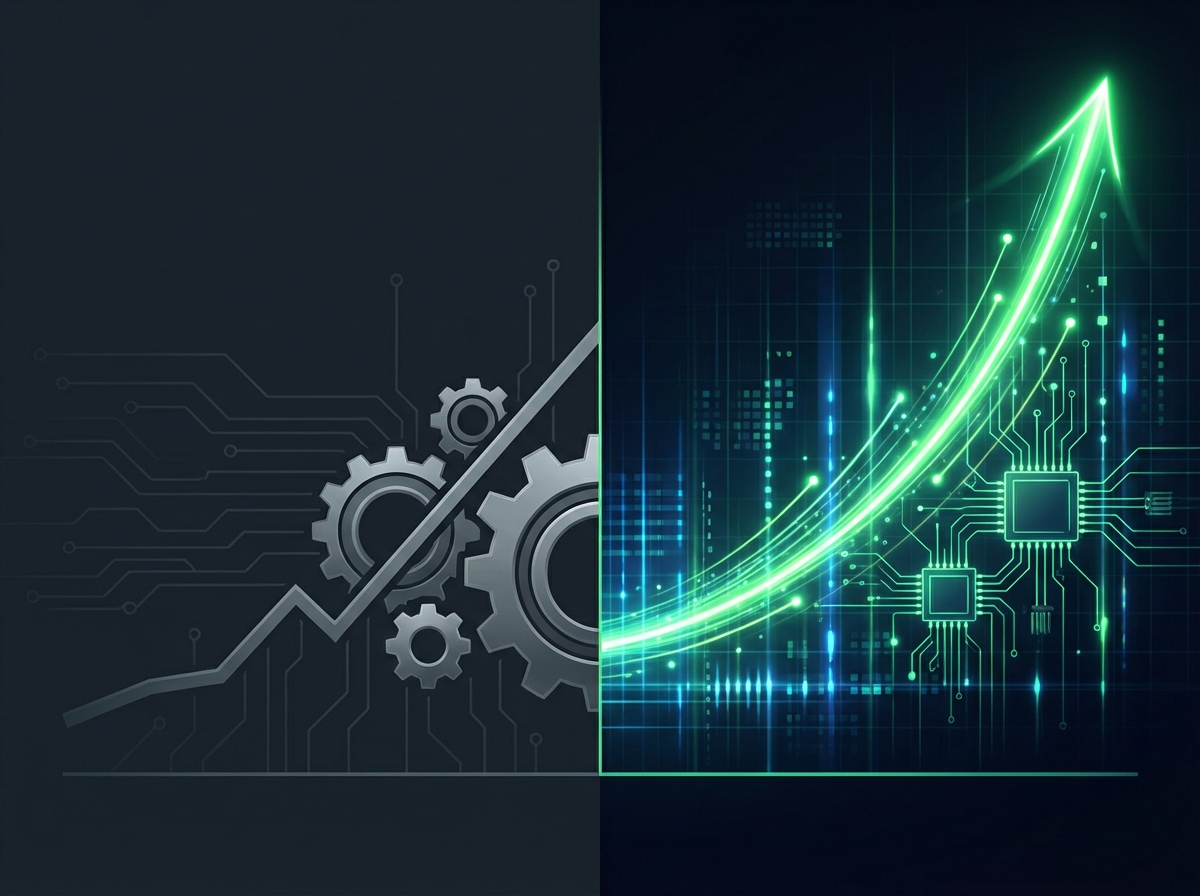
AI decouples this relationship, allowing for exponential scaling. By offloading low-leverage cognitive tasks to algorithms, a lean team can facilitate massive output without proportional hiring. When revenue creates a hockey stick curve while headcount remains a flat line, you unlock distinct economic advantages:
- A Defensive Moat: High RPE businesses accumulate cash reserves faster, allowing them to weather downturns that would bankrupt labor-heavy competitors.
- Talent Density: When you do not need to hire an army of junior employees to handle grunt work, you can afford to pay top-of-market salaries to retain a small circle of elite experts.
- Superior Margins: Without the linear drag of payroll growth, net profit margins expand significantly, turning the business into a capital-efficient engine rather than a pass-through entity.
Automating the 'Invisible Work' (Internal Operations)
Growth often breaks things. As you scale, the sheer volume of administrative glue—data entry, calendar tetris, and status updates—begins to clog the gears of your organization. We call this "invisible work." It rarely appears on a P&L statement, but it silently drains your team's cognitive battery, forcing talented employees to spend hours acting as human routers for information.
To decouple revenue from headcount, you must ruthlessly eliminate this friction. The solution lies in building Orchestration Layers.
An orchestration layer moves beyond simple task automation. Instead of just generating an email, it connects your disparate tech stack—CRM, Slack, and Project Management tools—via intelligent AI agents. These agents handle the critical "hand-offs" that usually require human intervention, ensuring data flows seamlessly between systems without manual oversight.
Consider the operational shift when an orchestration layer takes over:
- Unified Workflows: Instead of a sales rep manually updating a CRM, creating a Jira ticket for onboarding, and pinging the CS team on Slack, an AI agent detects a "Closed Won" status and executes all three actions simultaneously.
- Intelligent Scheduling: AI agents negotiate availability between internal and external stakeholders, booking times and preparing agendas without a single email exchange.
- Automated Data Hygiene: Rather than relying on humans to remember to input data, the orchestration layer scrapes relevant context from emails and calls, populating your databases automatically to ensure a single source of truth.
When you hand over these mechanics to AI, you aren't just saving time; you are upgrading the nature of your workforce. Your team stops servicing the process and starts driving the strategy, allowing you to scale output exponentially without adding a single new operational hire.

The Shift: From 'Doers' to 'Architects'
For decades, scaling a business was a linear equation: to double your output, you generally needed to double your headcount. These employees were primarily "doers," hired to execute specific, often repetitive tasks. Generative AI has fundamentally broken this correlation, demanding a complete restructuring of how we view talent. The value of a team member is no longer defined by how fast they can write code or draft emails, but by how effectively they can design the systems that do it for them.
This marks the era of the "Architect." Much like a building architect who drafts the blueprints rather than laying every brick, your team must transition from creating raw output to designing the workflows that generate it. They become the conductors of an automated orchestra, defining the parameters, setting the strategy, and letting the algorithms handle the heavy lifting of execution.
However, stepping back from execution does not mean stepping back from responsibility. As the manual workload decreases, the need for rigorous auditing increases. The human role shifts from creation to curation. Employees must develop a keen eye for quality assurance, verifying that the AI's output aligns with the brand voice and strategic goals. This requires a higher level of critical thinking than simple execution ever did, as the human must now act as the editor-in-chief of an infinitely productive digital workforce.
To navigate this transition successfully, leaders must prioritize aggressive upskilling. We cannot simply hand existing teams new tools without teaching them a new mindset. The workforce must evolve into:
- Prompt Engineers: Who understand the nuance of language needed to guide LLMs toward precise, high-quality results.
- System Managers: Who view the business as a series of interconnected API calls and automated triggers rather than a to-do list.
- Strategic Auditors: Who possess the domain expertise to spot hallucinations or mediocrity in AI-generated work instantly.
Ultimately, this is a cultural pivot. You are asking your team to stop working in the process and start working on the process. By turning your doers into architects, you unlock the ability to scale revenue exponentially while keeping headcount lean.

Scaling Personalization Without Scaling Support
There is a pervasive myth in business that automation kills intimacy. We tend to assume that if a human isn't typing the email or answering the phone, the experience is inherently cold. In reality, the opposite is often true. Humans are forgetful, tired, and constrained by cognitive load; AI is none of those things. By leveraging AI, companies can maintain a deep, contextual understanding of thousands of customers simultaneously, creating an experience that feels personal because it is precise.
Modern AI tools go far beyond basic chatbots. They can analyze customer sentiment in real-time, predict churn risks based on subtle usage patterns, and draft hyper-personalized communications. Instead of a support agent spending ten minutes digging through CRM logs to recall context, the AI instantly serves up a response that references specific user history, recent purchase behavior, and preferred tone. The human agent simply reviews and approves, transforming them from a typist into a strategic editor.
This dynamic facilitates a critical structural shift: the establishment of "Tier 0" support.
- Tier 0 (AI Resolution): This layer handles repetitive, high-volume queries instantly. It resolves issues rather than just deflecting them, satisfying the customer's need for speed without consuming headcount.
- Tier 1 (Human Resolution): Freed from the noise of routine tickets, your humans move up the value chain. They focus on complex problem-solving, emotional de-escalation, and high-touch relationship building.
By offloading transactional work to Tier 0, you aren't removing the human element. You are preserving your human talent for the complex, high-stakes interactions where empathy and strategy actually matter.