
The High Cost of Rigidity: Why SaaS is Losing its Luster
For nearly two decades, Software as a Service (SaaS) was heralded as the ultimate efficiency hack, promising low upfront costs and instant deployment. However, as enterprises mature, the initial shine is wearing off, revealing a landscape increasingly defined by diminishing returns and mounting frustrations. The most immediate grievance is purely financial: subscription fatigue. What begins as a manageable monthly operational expense quickly metastasizes into a massive budget drain. The industry-standard per-seat licensing model creates a compounding cost structure where success is essentially penalized; as your team grows, your software bill explodes, often without a corresponding increase in the value delivered.
Beyond the aggressive billing cycles, organizations are grappling with the reality of feature bloat. To justify constant price hikes, vendors continuously stuff their platforms with niche tools and complex add-ons that the average user never touches. The result is a painful inefficiency where enterprises pay full price for a sprawling suite of capabilities, yet their teams realistically utilize only about 20% of the platform. It is the digital equivalent of renting an entire office building when you only need a conference room.
Perhaps the most damaging cost, however, is not monetary but operational. SaaS platforms are built for the mass market, relying on a "one-size-fits-all" architecture that inherently lacks nuance. This rigidity forces companies into a difficult position regarding their internal processes:
- Forced Adaptation: Instead of the software supporting the business, teams are forced to dismantle their unique, optimized workflows to fit the rigid limitations of the tool.
- Homogenization: When every competitor in the industry uses the exact same software with the exact same constraints, operations become homogenized, stripping away the competitive advantage derived from unique service delivery.
In this environment, the convenience of off-the-shelf solutions is increasingly outweighed by the friction of rigidity, driving forward-thinking leaders to reject the idea of forcing their distinct business processes into a generic software box.
The Technology Shift: Building is no longer 'The Hard Way'
For years, the standard advice given to CTOs was simple: buy whenever possible, build only when necessary. The historical argument against custom development was well-founded; it usually implied bloated engineering teams, multi-year timelines, and the inevitable accumulation of crushing technical debt. However, the calculus has fundamentally changed. We have entered an era where the friction of software creation has been drastically reduced, making the "build" option not just viable, but often more efficient than wrestling with rigid SaaS integrations.
This shift is driven by a convergence of three distinct technological accelerators that have democratized development:
- AI-Augmented Coding: With the advent of AI coding assistants like GitHub Copilot and ChatGPT, developers are no longer starting from a blank screen. These tools act as force multipliers, handling boilerplate code, generating unit tests, and debugging in real-time. This allows senior engineers to focus on architecture rather than syntax, significantly speeding up development cycles.
- Modern Frameworks & Infrastructure: The days of racking physical servers and writing assembly are long gone. Modern ecosystems—reliant on composable architecture, serverless functions, and robust open-source libraries—mean that teams are assembling pre-built, high-quality blocks rather than reinventing the wheel.
- Low-Code/No-Code Platforms: For internal tools and workflows, platforms have matured to the point where non-technical staff can build functional solutions. This relieves pressure on core engineering teams, allowing them to focus on high-value custom software while the rest of the organization self-services their operational needs.
The cumulative effect of these technologies is a massive reduction in Time-to-Market (TTM). What once required a twelve-month roadmap can now often be prototyped in weeks and deployed in months. Furthermore, the maintenance overhead—historically the biggest deterrent to building—is mitigated by AI tools that assist with documentation and refactoring. Building custom software is no longer a luxury reserved for tech giants; it is accessible to any enterprise willing to leverage the modern stack.

Strategic Hybridity: Knowing When to Build vs. Buy
Let’s be clear: the shift toward custom software is not an “all-or-nothing” rebellion against the cloud. Attempting to rebuild every tool in your arsenal is just as dangerous as drowning in subscription fees. The most successful enterprises are adopting a philosophy of strategic hybridity—a nuanced approach where you buy what you need and build what sets you apart.
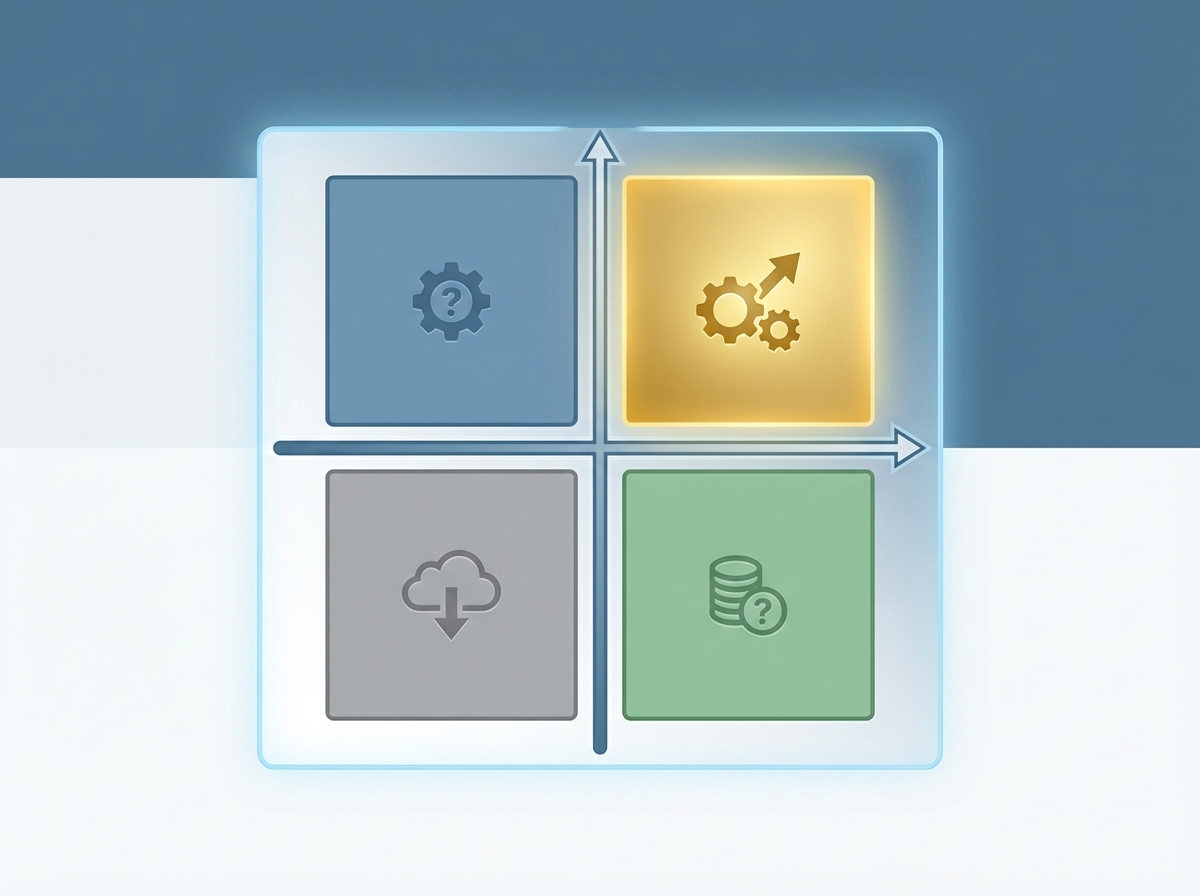
To navigate this transition, leaders need a rigorous decision-making framework. The most effective method involves categorizing your tech stack into two distinct buckets: Commodity and Core.
- The "Buy" Bucket (Commodity Functions): These are non-differentiating necessities. Being 10% better at processing payroll or sending internal emails will not win you more market share. Tools for HR, general accounting, and standard communication (like Slack or Microsoft Teams) should remain SaaS. Vendor economies of scale make these solutions impossible to beat internally.
- The "Build" Bucket (Core Competencies): These are your competitive advantages. This includes customer-facing experiences, proprietary logistics algorithms, and specific data modeling systems. If a standard SaaS platform forces you to compromise your unique workflow to fit their rigid template, it is time to build.
To identify the highest ROI for custom development, conduct a friction audit of your current stack. Look for the specific points where your team resorts to complex spreadsheets to bridge gaps between disconnected SaaS tools. Those gaps represent the failure of off-the-shelf software to meet your specific needs and are the perfect candidates for custom development. By reserving your engineering resources for high-impact, proprietary solutions and leaving the utilities to the vendors, you maximize value without reinventing the wheel.
The IP Imperative: Differentiation in a Cookie-Cutter World
There is a fundamental paradox in the modern SaaS landscape: the tools designed to make businesses more efficient are simultaneously leveling the playing field to a standstill. When you and your fiercest competitors run your operations on the exact same CRM and ERP platforms, utilizing the same “industry-standard” templates, you inevitably hit a ceiling of operational parity. You are only as fast, agile, or innovative as the vendor’s latest feature release allows you to be.
This realization is driving the shift toward custom software as a mechanism for Intellectual Property (IP) creation. By building proprietary solutions, enterprises are doing more than just solving technical problems; they are encoding their unique business logic—their “secret sauce”—into a digital asset that competitors cannot simply replicate by purchasing a license. Owning the IP allows an organization to build defensible moats around their specific workflows, ensuring that their operational advantages remain exclusive.
Furthermore, this approach fundamentally reframes the role of the IT budget. In a pure SaaS model, software is a perpetual rental cost—a necessary evil on the balance sheet. Conversely, investing in custom software transforms that spend from a cost center into an asset generator. The resulting platform becomes a piece of equity that increases the company’s valuation, offering strategic leverage that rented software simply cannot provide.