
The Evolution: From Rigid RPA to Autonomous Agents
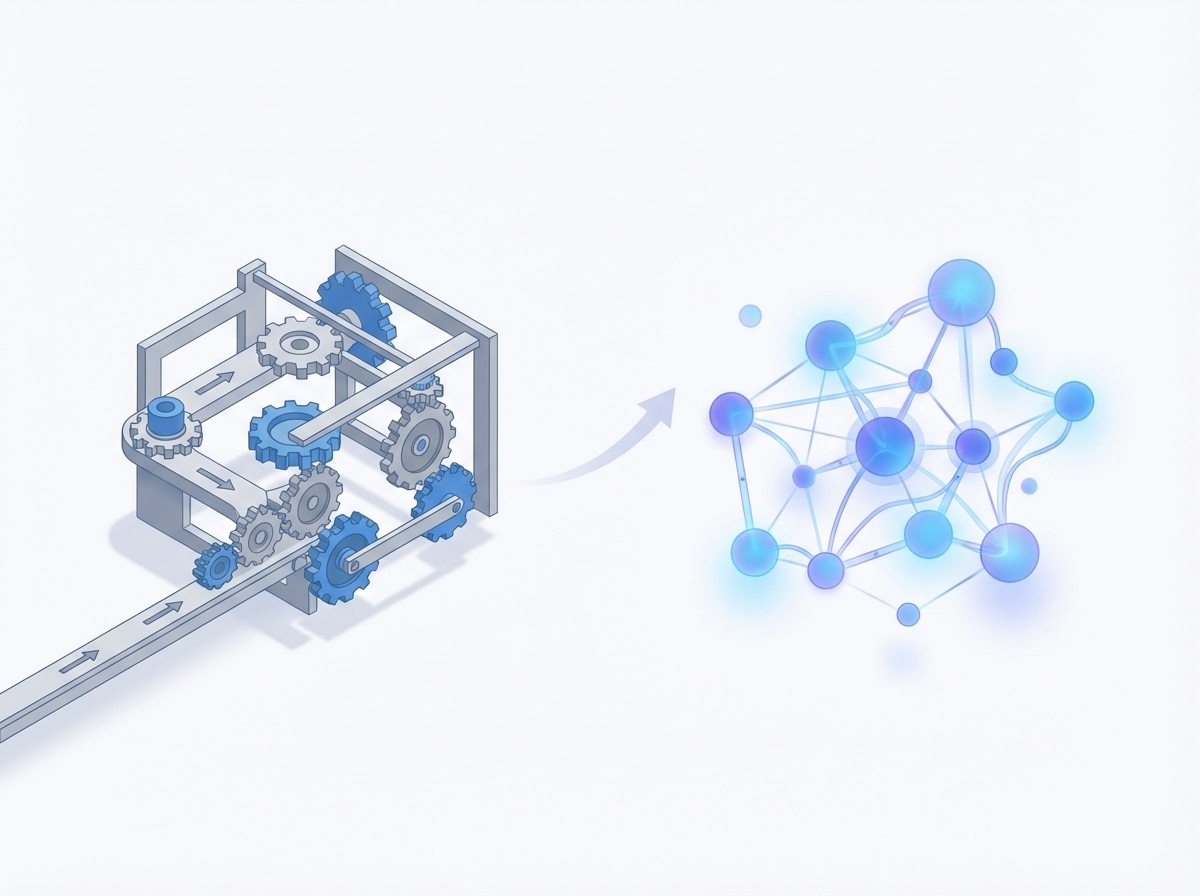
To understand the power of Agentic AI, we first need to look at the systems it leaves behind. For years, organizations have relied on Robotic Process Automation (RPA) and standard chatbots to handle routine workflows. These traditional tools are inherently deterministic and strictly rule-based. They operate on rigid "if-this-then-that" logic, making them highly effective for predictable, repetitive tasks. However, they lack flexibility. If a user deviates from the expected script or an unforeseen exception occurs, these systems simply break down and require human intervention.
Agentic AI represents a massive leap forward. Unlike its predecessors, Agentic AI is probabilistic, goal-oriented, and capable of self-correction. Instead of requiring developers to map out every conceivable user journey or edge case, you simply provide an Agentic system with a specific objective, boundaries, and access to a set of tools.
This fundamentally changes how we design and interact with software. We are witnessing an operational shift from executing a pre-programmed path to independently reasoning how to achieve a desired outcome. An autonomous agent does not just blindly follow a static flowchart; it actively evaluates the best way to solve the problem in front of it.
This autonomy is powered by iterative reasoning loops. When presented with a complex objective, an agentic system uses these loops to navigate ambiguity and reach its goal:
- Analyze the request: Break down the overarching goal into smaller, logical milestones.
- Formulate a plan: Determine which functions, tools, or APIs are required to execute the immediate next step.
- Take action and evaluate: Execute the step and critically observe the outcome against the expected result.
- Self-correct: If a step fails, hits an error, or yields unexpected data, the agent dynamically adjusts its approach, devises a new strategy, and tries again.
This continuous cycle of action, observation, and course correction is exactly what separates a brittle, basic bot from a truly resilient and intelligent agent.
Upgrading Your Technical Infrastructure
Transitioning from a simple conversational interface to a fully autonomous agent requires a fundamental shift in your technology stack. You can no longer rely on basic request-response loops. Instead, you need an architecture designed for autonomy, memory, and action.
The first major leap is moving from static APIs to dynamic tool-use capabilities. Basic chatbots pull pre-defined data, but agentic AI needs to actively interact with its environment. This means equipping your system with secure, programmable interfaces that allow the agent to read, write, and execute functions on the fly. Whether it is updating a CRM, executing a custom script, or sending an email, your infrastructure must support real-time, dynamic tool calling backed by stringent access controls.
Next, true autonomy requires persistent context. Agents need to remember past interactions, understand evolving user preferences, and reference massive datasets instantly. Integrating a vector database is essential for establishing this contextual, long-term memory. By converting documents and past conversations into searchable mathematical embeddings, vector databases empower your agent to retrieve highly relevant information in milliseconds. This ensures the AI's actions are continuously informed and historically accurate.
Finally, an agent is only as capable as its ability to think ahead. You must establish a robust orchestration layer to manage the AI's cognitive workload. This layer acts as the central brain of your system, empowering the agent to:
- Plan: Break down a high-level user prompt into a logical sequence of smaller, actionable tasks.
- Reason: Evaluate the outcome of each step, handle errors dynamically, and self-correct to decide the next best action.
- Execute: Coordinate complex, multi-step sequences across various tools and databases without losing the original context.
By upgrading these three core pillars—dynamic tool-use, vector-driven memory, and robust orchestration—you effectively transform a passive chatbot into a proactive, agentic problem solver.

Governance, Security, and Operational Guardrails
Agentic AI moves beyond conversational text generation into the realm of autonomous execution. While this autonomy drives massive efficiency gains, it also introduces significant operational risks. If a standard chatbot hallucinates, it might output a confusing sentence. However, if an agentic AI hallucinates while holding write-access to a live production database, the results can be catastrophic. Unchecked agents also amplify the risk of data privacy breaches and compliance violations, especially in highly regulated industries.
To mitigate these risks, architects must embed strict operational guardrails directly into the foundation of the AI system. You cannot simply give an AI agent broad system permissions. Instead, you must design a framework that strictly limits the blast radius of any autonomous action.
Implementing a secure agentic architecture requires focusing on three core pillars:
- Dynamic Role-Based Access Control (RBAC): Traditional static permissions are insufficient for AI. Agents require dynamic, context-aware access controls. Equip agents with temporary, least-privilege credentials that are scoped entirely to the specific task they are executing.
- Human-in-the-Loop (HITL) Safeguards: Not all actions should be fully autonomous. For high-stakes operations—such as executing financial transactions, modifying critical infrastructure, or accessing sensitive customer data—the system must automatically pause and require explicit human authorization before proceeding.
- Continuous Auditing and Logging: Every decision an agent makes must be fully transparent. Implement robust, immutable logging for every API call, database query, and logic path the agent takes. This comprehensive telemetry is essential for real-time monitoring, compliance audits, and post-incident forensics.
By prioritizing governance and security from day one, organizations can safely harness the power of agentic AI. These guardrails ensure your autonomous systems operate reliably, securely, and strictly within the boundaries of your business intent.

Redesigning Workflows for Human-AI Collaboration
To truly leverage agentic AI, organizations cannot simply plug autonomous agents into existing, linear processes. Business workflows must structurally evolve. Instead of humans driving every step and occasionally querying an AI for answers, the paradigm shifts to AI taking proactive action while humans provide oversight and strategic direction. This requires a fundamental redesign of how work is orchestrated.
Central to this redesign is understanding the evolving nature of human involvement. Traditional models rely heavily on Human-in-the-loop (HITL) workflows, where the AI pauses and waits for explicit human approval before executing almost any significant action. As systems become more agentic, organizations must transition toward Human-on-the-loop (HOTL) architectures. In a HOTL setup, the agent operates autonomously within predefined boundaries, while human operators monitor the system's ongoing performance and intervene only when necessary.
Making this transition safely requires breaking down monolithic workflows into smaller, modular tasks. Large, complex processes managed by a single AI prompt or system are prone to cascading errors and hallucination. By compartmentalizing workflows, you can assign agents to specific, well-defined functions independently. Modularization limits the blast radius of potential mistakes and makes it significantly easier to track agent performance, update instructions, and scale operations.
Of course, even the most advanced agents will encounter edge cases. To maintain operational continuity, these redesigned workflows must establish clear hand-off protocols. Effective collaboration relies on the agent recognizing its limitations and routing complex problems to a human without friction. A robust hand-off protocol should include:
- Confidence thresholds: Agents must be programmed to automatically trigger a human review if their confidence score for a proposed action drops below a strict, acceptable metric.
- Context preservation: When an escalation occurs, the human operator must instantly receive the full history, underlying reasoning, and context of the agent's work up to that point, eliminating the need to start the task from scratch.
- Continuous feedback loops: Human resolutions to edge cases should be structurally captured and fed back into the system to refine the agent's future autonomous decision-making capabilities.