
The MVP Misunderstanding: It's Not a Half-Built House
One of the most pervasive myths in product development is the idea that "minimum" equals "incomplete." Too many teams treat the MVP as an excuse to release a product that is functionally buggy, visually unpolished, or difficult to navigate. However, shipping a car without wheels isn’t an MVP; it’s just a broken car. The objective is not to build a half-finished product, but rather to build a smaller, entirely self-contained product.
To understand the difference, consider the "Dry Cake vs. Cupcake" analogy. This illustrates two very different approaches to scoping your initial release:
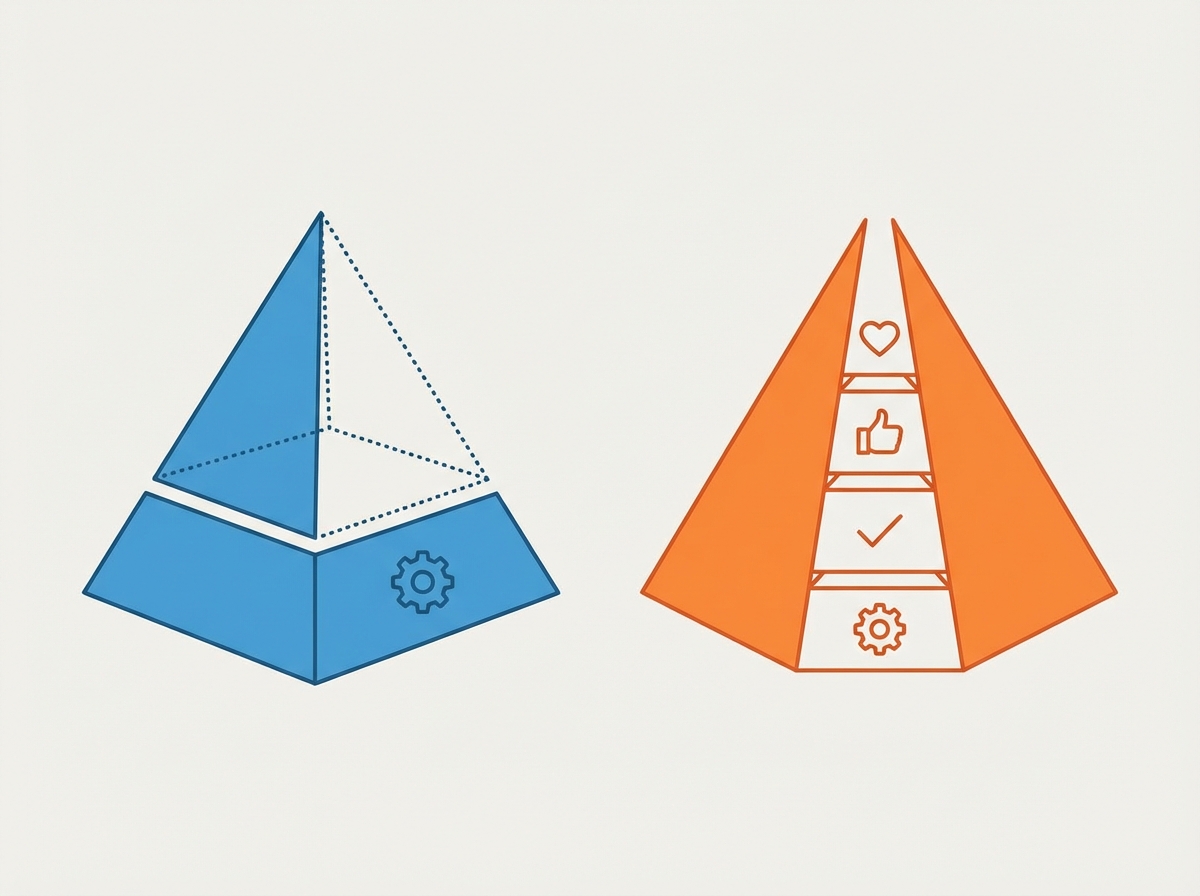
- The Dry Cake (The Common Mistake): This approach builds only the bottom functional layer of the product. It technically works, but it lacks design, flavor, and usability. It is a dry, boring base that fails to engage users or prove the product's value.
- The Cupcake (The True MVP): This approach represents a vertical slice of the final vision. It is small, but it includes the cake, the filling, the icing, and the sprinkles. It offers a complete, delightful experience on a smaller scale.
This "cupcake" philosophy aligns perfectly with Aaron Walter’s Hierarchy of User Needs. A successful MVP doesn't just check the box for "Functional" at the bottom of the pyramid while ignoring the rest. Instead, it must cut a vertical slice through all four layers: Functional, Reliable, Usable, and Pleasurable. Even if your MVP only does one thing, it must do that one thing reliably and delightfully. If you ask users to test a product that is purely functional but frustrating to use, you aren't validating your idea; you are merely testing their patience.
The Hidden Cost of Speed Over Quality
In the frantic rush to beat competitors to market, it is tempting to strip a product down to its barest bones. While the "Minimum" in MVP is essential for agility, focusing too heavily on speed often creates a product that is technically functional but emotionally hollow. Shipping too early doesn't just result in a lack of features; it often results in a surplus of friction that alienates early adopters.
This friction triggers a psychological barrier known as First Impression Bias. Modern users have nearly zero tolerance for buggy or counterintuitive interfaces. If their initial interaction with your application is frustrating, they rarely stick around to wait for the "polished" V2 update. Instead, they churn immediately. Winning these users back is infinitely harder—and significantly more expensive—than acquiring them in the first place.
Beyond immediate retention issues, rushing creates a form of compounding interest known as Experience Debt. Much like technical debt, where messy code slows down future development, Experience Debt consists of quick-fix design choices and "good enough" workflows that become embedded in the product's DNA. As the codebase grows, these flaws calcify:
- Convoluted Workflows: New features get bolted onto a shaky foundation, making simple tasks increasingly complex for the user.
- Design Inconsistency: A lack of a coherent design system leads to a fragmented interface that dilutes brand identity.
- Costly Refactoring: Fixing fundamental UX problems later often requires a complete overhaul rather than simple iterations.
Ultimately, saving a few weeks during the initial build phase can cost months of remediation down the line, turning your roadmap into a perpetual game of catch-up rather than innovation.

A Framework for High-Impact Scoping
Effective scoping is not about hacking away features until you reach an arbitrary deadline; it is the art of distilling a product down to its most critical value proposition. To solve the MVP paradox, product leaders must shift their mindset from simply building a "minimum" product to testing the "riskiest" hypothesis.
This approach is often referred to as Riskiest Assumption Testing (RAT). Instead of asking, "How much can we build in three months?" ask, "What is the single most dangerous assumption that could kill this business, and what is the smallest experiment required to validate it?" By focusing on the unknown rather than the known, you avoid wasting resources on robust features for a product nobody wants.
To execute this without sacrificing quality, apply the classic "Skateboard to Car" analogy. If your goal is to help a user get from Point A to Point B faster, you should not scope the project by building a pile of wheels, then an axle, and finally a chassis. That approach offers zero value until the final deployment. Instead, structure your iterations to deliver a complete vehicle at every stage:
- Iteration 1 (The Skateboard): It may be manual and basic, but it gets the user to their destination faster than walking. It is a functional, usable product.
- Iteration 2 (The Scooter): You add a handle for stability, immediately improving the user experience.
- Iteration 3 (The Bicycle): You add gears and speed, expanding the product's range and utility.
When scoping your release, ensure every slice is a "skateboard"—a complete loop of value. If you must reduce scope, cut the breadth of features, not the depth of the core experience. A skateboard is a viable product; a car without an engine is just expensive scrap metal.

Defining 'Viable': The Core Loop Strategy
When founders rush to market, the word "viable" is frequently misinterpreted as "barely functional." However, in a competitive software landscape, a product that functions technically but fails experientially is often dead on arrival. To successfully balance development speed with user satisfaction, you must identify and ruthlessly perfect your Core Loop.
The Core Loop is the single, cyclical action a user takes to derive value from your product. It is the heartbeat of your application. For a ride-sharing app, the core loop isn't editing a profile picture or viewing past receipts; it is successfully hailing a ride. For a project management tool, it is creating and completing a task.
Your MVP strategy should operate on a strict hierarchy where quality is distributed unevenly:
- Secondary features (like advanced filters, social integrations, or dark mode) can be rough, manual, or entirely missing at launch.
- The Core Loop must be polished, intuitive, and completely friction-free.
This distinction is critical. Users will forgive a clunky settings menu or a missing "export to PDF" button, but they will not forgive a laggy or confusing primary interface. If the main reason they signed up feels difficult to use, they won't stick around to see what features you ship in the next update.
Ultimately, the trade-off is clear: it is better to solve one specific problem perfectly than to solve five problems poorly. By narrowing your scope to a pristine Core Loop, you deliver immediate value and earn the user trust required to build out the rest of the ecosystem later.