Injecting Automation Across Your Dev Cycle
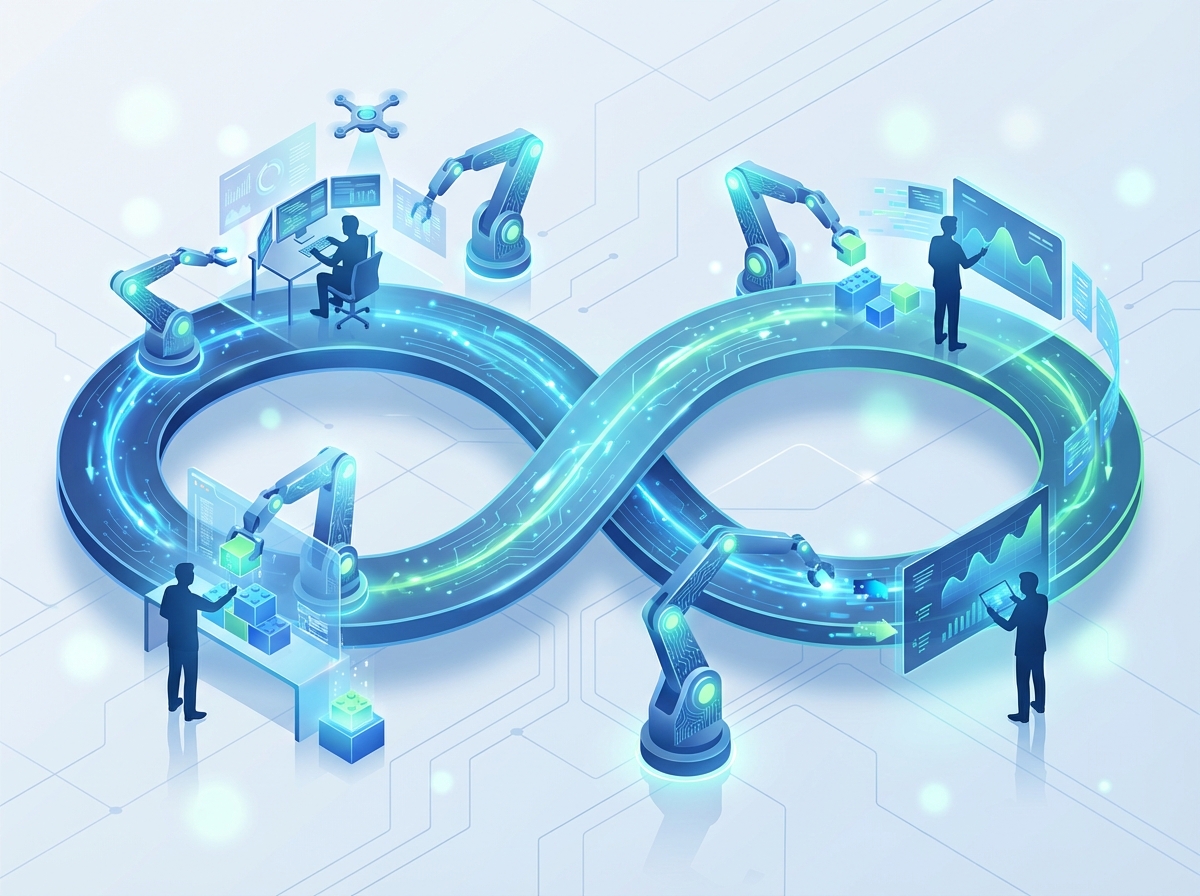
The traditional Software Development Life Cycle (SDLC) is notorious for hidden bottlenecks. From writing mundane setup scripts to hunting down elusive bugs, engineering teams waste countless hours on repetitive tasks. By injecting AI-driven automation directly into your dev cycle, you can reclaim that time and radically accelerate product velocity.
Scaling lean requires you to systematically target these inefficiencies. By pinpointing high-impact AI touchpoints, you can transform a sluggish SDLC into a high-speed innovation engine. Here is where artificial intelligence makes the most immediate impact:
- Automated Boilerplate Code Generation: Modern AI coding assistants do much more than simple auto-complete. They instantly generate foundational boilerplate code, scaffold entire project structures, and draft routine unit tests. This empowers your developers to skip the tedious setup phase and dive straight into building core, high-value features.
- AI-Driven Bug Tracking and Remediation: Finding and fixing errors traditionally derails development sprints. Today, AI-powered tools analyze your codebase in real-time to flag vulnerabilities before code is even merged. When bugs do surface, intelligent systems trace the root cause, predict potential cascading failures, and automatically generate patch recommendations.
- Intelligent CI/CD Pipelines: Continuous integration and deployment are the heartbeat of agile delivery. Intelligent agents now oversee these pipelines by dynamically allocating resources, prioritizing critical test suites, and predicting build failures before they happen. This optimizes the entire release process and drastically reduces your overall time-to-market.
Integrating these automated touchpoints creates a nearly frictionless development environment. When your SDLC manages its own busywork, your team can focus entirely on driving sustainable product growth.
Empowering Product Teams with Autonomous Agents
While AI's impact on engineering velocity is well-documented, the next frontier of lean scaling shifts the focus directly to product management. Product managers often find themselves buried under an avalanche of qualitative data, feature requests, and administrative overhead. Autonomous AI agents are changing this dynamic, stepping in as intelligent partners to shoulder the operational burden.
By deploying these agents, product teams can fundamentally transform how they handle daily workflows. Instead of getting bogged down in execution, PMs can leverage AI to automate their most time-consuming tasks:
- Automating User Feedback Analysis: AI agents can ingest vast amounts of unstructured qualitative data from support tickets, survey responses, and user interviews. They instantly synthesize this information, spotting emerging trends and gauging user sentiment in real-time.
- Auto-Prioritizing the Backlog: Rather than relying on tedious manual sorting, AI can auto-prioritize backlog items by grouping them into semantic themes. Agents analyze the weight of user requests and map them to strategic goals, suggesting clear priority levels for the development pipeline.
- Generating Baseline Product Specs: Autonomous agents accelerate the discovery phase by instantly drafting baseline product specifications. By feeding the AI a core problem statement, PMs receive a comprehensive first draft of requirements, user stories, and acceptance criteria.
The ultimate goal of integrating these autonomous agents is elevation, not replacement. By removing the friction of data parsing and document drafting, AI-driven automation frees up product managers to focus on what truly matters: deep strategic thinking, cross-functional alignment, and crafting a winning product vision.
The Evolution of Lean: Why AI is the Ultimate Multiplier
The traditional lean startup methodology taught us to build, measure, and learn. It was all about eliminating waste and validating ideas with minimal resources. But in today’s hyper-competitive landscape, relying solely on human speed is no longer enough. We are witnessing a fundamental shift from traditional lean practices to AI-enhanced operations, where artificial intelligence does not just support the product development process—it completely supercharges it.
For years, automation was simply about working faster. We used software to eliminate repetitive tasks, yet the fundamental structure of the work remained exactly the same. Today, AI agents are actively changing this paradigm. They do not just execute pre-programmed steps; they analyze vast amounts of data, make autonomous decisions, and adapt in real time. This transitions product teams from merely accelerating their daily output to structurally reinventing how work gets done from the ground up.
This structural shift elevates lean operations in several critical ways:
- Predictive Validation: AI analyzes market signals and user sentiment to validate product features before a single line of code is written.
- Automated Iteration: Intelligent co-pilots can independently run experiments, analyze user feedback, and deploy real-time optimizations.
- Dynamic Resource Allocation: Smart systems instantly deploy limited capital and human effort exactly where they will yield the highest return.
Ultimately, these AI agents act as an elite team of co-pilots alongside your human talent. For lean startups and agile growth teams, the greatest friction has always been the wide gap between limited funding and sky-high ambition. AI effectively bridges this gap. By operating as the ultimate multiplier rather than just another operational tool, artificial intelligence empowers lean teams to punch far above their weight class, delivering rapid, enterprise-level growth without the massive overhead.
Navigating the Risks: Quality Control and 'Human-in-the-Loop'
While AI offers incredible leverage for lean teams, moving at breakneck speed introduces a unique set of hazards. Rapid AI integration without proper oversight can quickly lead to a buildup of AI-generated tech debt. When developers rely too heavily on automated code generation without thorough review, inefficient or bloated code can quietly accumulate, eventually slowing down the very product it was meant to accelerate.
Beyond technical debt, product teams must remain vigilant against AI hallucinations. When algorithms confidently present false or nonsensical information, it threatens product reliability and user trust. Furthermore, over-automating the creative process risks stripping away the human touch from product design. An AI might generate a highly functional user interface, but it lacks the genuine empathy required to create a truly delightful user experience.
To mitigate these risks without sacrificing speed, lean teams must establish robust human-in-the-loop (HITL) safeguards. HITL ensures that artificial intelligence acts as a powerful assistant rather than an autonomous decision-maker. Here are actionable best practices to effectively integrate human oversight:
- Define strategic intervention points: Instead of micromanaging every AI output, mandate human approval at critical junctures. Require manual reviews for final code merges, customer-facing copy, and core architectural changes.
- Build automated guardrails: Implement strict automated testing to catch basic AI-generated errors before they reach a human. Flag only the anomalies and complex edge cases for your team to review.
- Schedule AI tech debt audits: Treat AI-generated code just like human code. Schedule regular refactoring sprints to clean up inefficiencies and ensure long-term codebase maintainability.
- Protect design empathy: Use AI to rapidly prototype wireframes or process user feedback data, but leave the final polish to human designers who can inject brand personality and emotional resonance.
Ultimately, a successful human-in-the-loop approach does not create bottlenecks. Instead, it builds a sustainable foundation for growth, ensuring that your rapidly scaling product never compromises on quality or user trust.